
★ Checkout monitoring for WooCommerce agencies
Protect client checkout revenue.
CashFlowCanary shows which checkout threatens revenue, how much is exposed and what proof to share with the client.
- 70% cart abandonment
- Revenue/min estimate
- ROI proof
- Merchant compatible

Cyber Canary signal
Every client funnel becomes a financial decision signal.
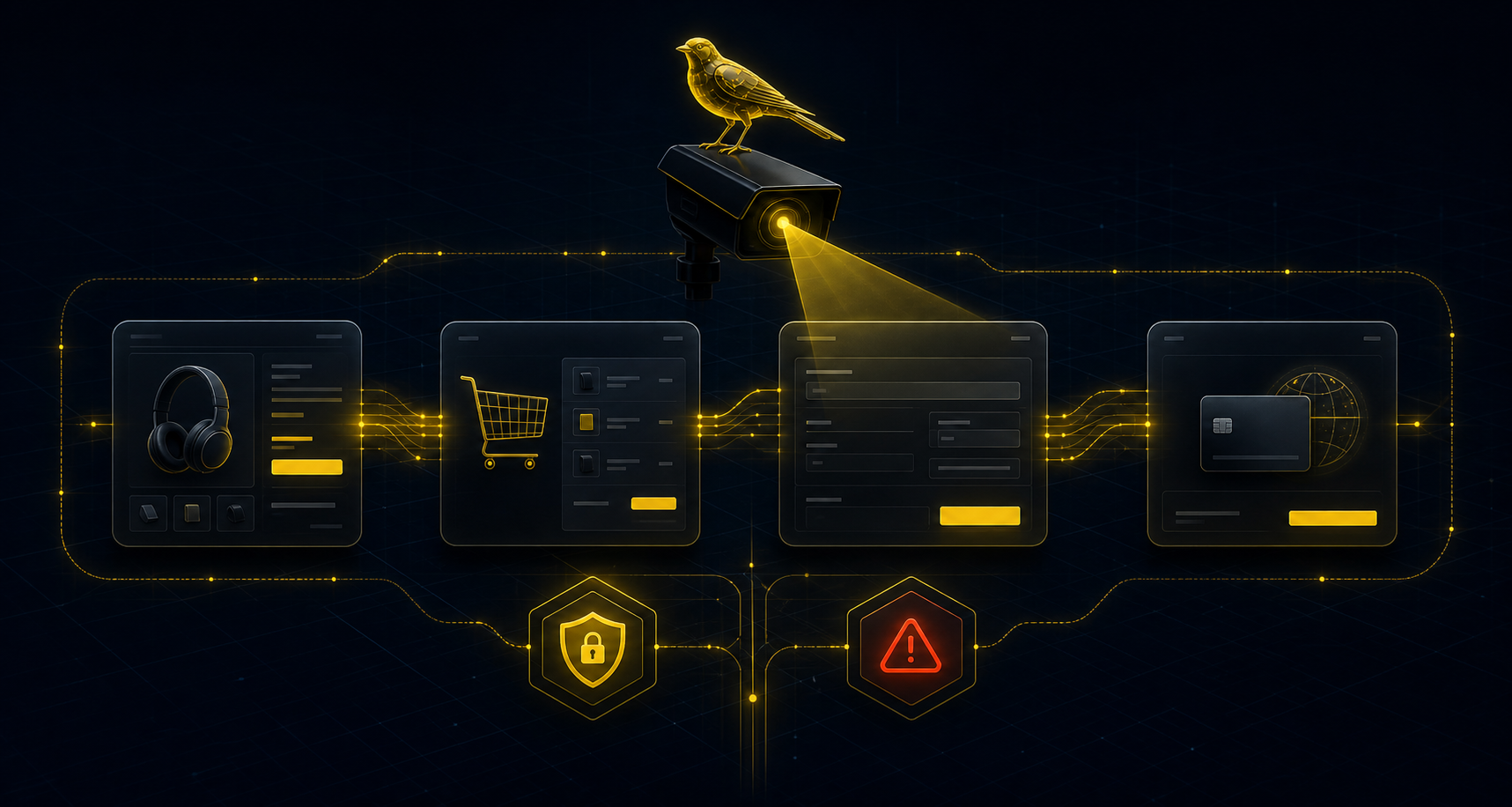
Product, cart, checkout and payment steps are connected site by site. When one step drops, the cockpit shows which client to handle, how much revenue is exposed and what proof to share.
- Read-only monitoring
- No real payment
- Proof per client site
A broken checkout is priced by the minute
CashFlowCanary puts the economics of an incident up front: market benchmarks, a simple exposed-revenue estimate and proof of recovery. Amounts remain indicative and specific to each store context.
70.19% average cart abandonment
Baymard aggregates e-commerce studies and places average cart abandonment around 70%. When checkout breaks, part of that friction becomes a direct loss to qualify.
Up to 35.26% checkout conversion upside
Baymard estimates that better checkout design can yield up to 35.26% conversion uplift on large sites. CashFlowCanary does not redesign checkout: it detects breakages that prevent that potential from existing.
Exposed revenue = hourly revenue / 60 × minutes lost
Example: €12,000 daily revenue across 12 active hours is about €16.70 per minute. A 45-minute checkout outage exposes roughly €750 before support and reputation cost.
0.1 s can matter in mobile retail
The Deloitte/Google study observed that a 0.1 s mobile speed improvement can be associated with +8.4% retail conversion. Checkout incidents and slowdowns deserve their own signal.
IT downtime: $5,600/min Gartner benchmark
Atlassian cites Gartner's $5,600 per minute average IT downtime benchmark. Smaller stores should calculate their own exposed revenue rather than copying that number.
ROI: reduce discovery delay
The gain is not magic: it comes from reducing the time between breakage, detection, alert, AI intervention on paid plans and proof of recovery.
From potential loss to fix, without useless debate
Connect a client site
Revenue-critical steps are observed at the cadence of the selected plan, without persistent action on the store.
The cockpit estimates exposure
Anomalies are ranked, dated and linked to a financial order of magnitude so the team handles the biggest revenue threat first.
Report back with proof
Reports, diagnosis, impact estimate and recommendations speed up the fix and make the situation easy to share with the client.
Built first for WooCommerce agencies
CashFlowCanary gives WooCommerce agencies a portfolio view while staying useful for a merchant monitoring their own checkout.
Prioritized portfolio
Sites that threaten revenue rise above comfort signals, so the team knows which client to handle first.
Client handoff
Each incident produces filtered, shareable proof without exposing cart or payment data.
Same logic per site
An agency follows many stores; a merchant follows one. The cockpit keeps one answer: can this checkout take orders?
A value page, not another pricing grid
Site-by-site view
Product, cart and checkout are tracked site by site, like revenue lines to defend.
Portfolio priority
The team separates the blocked client from the secondary signal, without rereading a wall of logs.
Actionable proof
Each alert keeps the useful context: signal, time, observed state and priority.
Assisted diagnosis
The team gets a correction-oriented reading, with concrete leads and no persistent action.
Client handoff
Incidents become readable PDFs for the client, project manager or developer.
Controlled history
Data stays minimized, useful for trends and proportionate to each plan.
What you stop discovering too late
Revenue at risk, quantified
A client checkout can break while the site still responds. CashFlowCanary puts that financial risk ahead of secondary alerts.
Proof before debate
Each incident keeps useful context to understand, fix and explain without collecting customer data.
Clear handoff
Alerts, reports and cockpit views turn a technical signal into the next action the agency and merchant can read.