
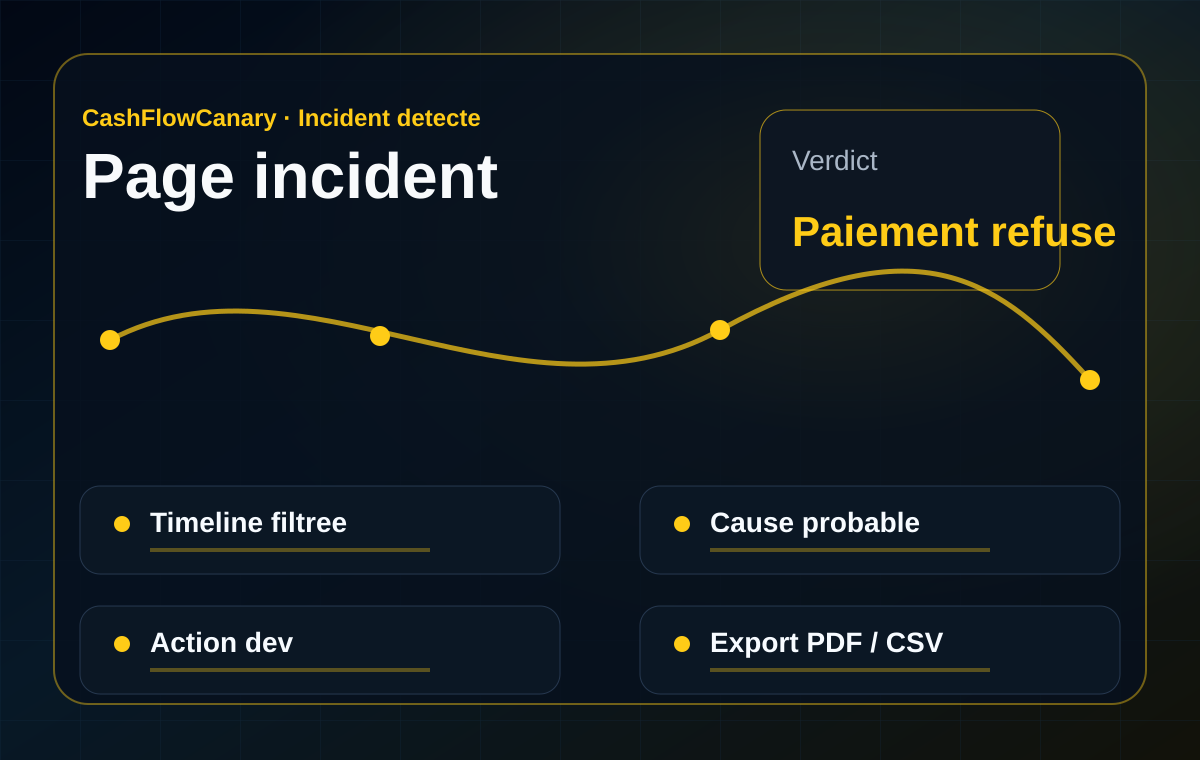
Before / after

See what changes when checkout turns green again.

This fictional example shows the difference between an open incident and a confirmed resolution: initial signal, expected correction, then filtered proof that the journey is green again.

Before correction

The goal is not to show a raw error screen, but to make the breakage understandable and shareable.

Observed signal

The journey reaches checkout, then finalisation fails in the demonstration scenario.

Kept proof

Affected step, status, timestamp, error class and filtered context are enough to open the incident.

Excluded data

No email, address, payment credential, cookie, detailed cart identifier or full payload.

After correction

Returning to green must be verified, not just announced.

CashFlowCanary also helps confirm that the action had the expected effect: the same critical journey is replayed and the incident can be closed with clean proof.

  • Same checkout step observed
  • Before and after proof separated
  • Closure readable by the client
Abstract CashFlowCanary before after correction example

What the after state must prove

Same scope

Resolution is compared on the same critical funnel: product, cart, checkout and payment.

Readable signal

The report clearly separates the initial incident, recommended action and post-check state.

Decision ready

The agency or merchant knows whether the incident can close or still needs watching.

1. Incident opened

The priority check sees that checkout still responds, but the final step does not validate the order in the fictional scenario. The incident opens because the revenue journey is affected.

2. Targeted correction

The team checks the payment method, checkout module, cache and recent WooCommerce changes. CashFlowCanary does not fix the store for the team; it keeps proof and guides the next action.

3. Re-verification

After correction, the same critical journey is verified again. The report can then show the move from action needed to green, with filtered signals.

4. Format limits

  • The example is fictional and does not map to any real store.
  • Before/after proof does not expose end-customer data.
  • A green check does not replace a complete business acceptance test for the store.
  • Report retention depends on plan rights and retention rules.